






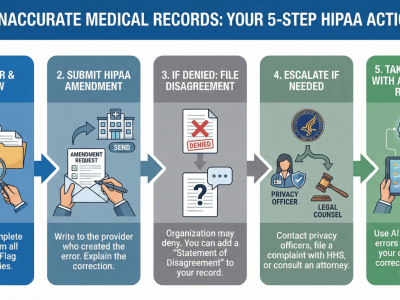













If you have ever tried to request your medical records from a hospital, you already know it is rarely as simple as asking. You are often routed to a third-party records vendor, asked to pay per-page copying fees, or simply ignored for weeks.
Many major health websites will tell you to “just fill out a medical records request form.” But what they don’t tell you is what to do when the hospital pushes back.
Under the Health Insurance Portability and Accountability Act (HIPAA), you have a federally protected right to access your health data. The government is actively enforcing this. In early 2025, the U.S. Department of Health and Human Services (HHS) fined Oregon Health & Science University (OHSU) $200,000 and Memorial Healthcare System $100,000, specifically for failing to provide patients with timely access to their records.
In this guide, we will bypass the generic advice. We will show you exactly how to request medical records from a hospital, expose the common delay tactics records departments use, and provide you with the exact email templates to force compliance.
Understanding Your HIPAA Right of Access
The HIPAA Privacy Rule establishes a patient’s “Right of Access.” This means a hospital, clinic, or health insurance plan is legally required to provide you with a copy of your protected health information (PHI) upon request.
The 30-Day Rule
By federal law, a hospital must fulfill your HIPAA medical records access request within 30 calendar days of receiving it. They are allowed a single 30-day extension, provided they give you a written reason for the delay. If you are waiting 60 days or more, the hospital is in violation of federal law.
The Fee Limits
Hospitals cannot charge you whatever they want for your records. Under HIPAA, they can only charge a “reasonable, cost-based fee” for the labor and supplies required to create the copy. If you request your records electronically (e.g., via a secure email or a CD), they cannot charge you per-page fees for printing.
Unpaid Bills Do Not Matter
A hospital cannot withhold your medical records because you have an unpaid medical bill. This is a direct HIPAA violation. Your health data belongs to you, regardless of your financial standing with the facility.
3 Common Hospital Delay Tactics (And How to Beat Them)
Records departments are often understaffed and overwhelmed. To manage the backlog, they sometimes rely on tactics that frustrate patients into giving up. Here is how to navigate them.
Tactic 1: “You must use our specific portal to request records.”
The Reality: While hospitals prefer you use their internal medical records request form, HIPAA explicitly states that a provider cannot require you to use a portal if it creates an unreasonable barrier.
How to Beat It: Submit your request in writing (via email or certified mail) clearly stating your HIPAA right of access. We have provided a template below.
Tactic 2: “We sent it to your new doctor, we can’t give it directly to you.”
The Reality: Hospitals often prefer provider-to-provider transfers because they are accustomed to that workflow. However, you have the absolute right to receive the records directly.
How to Beat It: Specify in your request that the records must be delivered directly to you in an electronic format (like a PDF). Once you have the files, you can upload them to an independent personal health record platform like MyMedicalRecords.ai, ensuring you never have to ask the hospital for them again.
Tactic 3: “The records are in archive, it will take 90 days.”
The Reality: The 30-day federal deadline applies whether the records are sitting on a desk or buried in an off-site digital archive.
How to Beat It: Remind the records department of the HHS Office for Civil Rights (OCR) Right of Access Initiative. Mentioning the OCR is usually enough to move your request to the top of the pile.
The Exact Template to Request Your Records
Do not leave room for interpretation. Copy and paste this template, fill in your details, and send it to the hospital’s Medical Records or Health Information Management (HIM) department.
Subject: Formal HIPAA Right of Access Request: [Your Full Name] – DOB: [Your Date of Birth]
To the Health Information Management Department, under the HIPAA Privacy Rule (45 CFR § 164.524), I am formally requesting a complete copy of my medical records for treatment received between [Start Date] and [End Date].
Please provide these records in an electronic format (PDF preferred). I am requesting that these records be delivered directly to me at this email address: [Your Email].
As required by federal law, please fulfill this request within 30 days. If there is a reasonable, cost-based fee for electronic delivery, please notify me immediately so it does not delay processing.
Please note that under HIPAA, I cannot be denied access to my records due to any outstanding medical balances. Thank you for your prompt attention to this matter.
Sincerely,
[Your Name]
[Your Phone Number]
[Your Address]
What to Do Once You Have Your Records
Fighting a hospital for how to get hospital records is exhausting. You should only ever have to do it once.
Once the hospital emails you that PDF or hands you a flash drive, the worst thing you can do is leave those files sitting in your downloads folder. If you see a new specialist next year, you will be right back where you started.
This is why we built MyMedicalRecords.ai.
Instead of relying on fragmented hospital portals, MMR allows you to organize, store, and securely share your medical records on your own terms.
- Epic MyChart Integration: If your hospital uses Epic, you can connect your MMR account to pull your records automatically—bypassing the records department entirely.
- AI Health Translation: Dense hospital discharge summaries are translated into plain-English smart summaries by our secure AI.
- Privacy First: Unlike free health apps that monetize your data, MMR has zero VC or Private Equity ownership. Your records live exclusively on U.S.-based servers, protected by the same strict privacy laws that govern hospitals.
Stop begging hospitals for your own health data. Take control of your medical history today.
Click the link in our bio to start your forever-free MyMedicalRecords.ai account.
Frequently Asked Questions (FAQ)
How long does a hospital have to provide medical records?
Under HIPAA, a healthcare provider must fulfill a medical records request within 30 calendar days. They can request a single 30-day extension if they provide a written reason for the delay.
Can a hospital refuse to give me my medical records?
In very rare cases (such as psychotherapy notes or if a doctor believes releasing the records will cause physical harm), a provider can deny access. However, they cannot refuse to release records because you owe them money for medical services.
How do I report a hospital for withholding medical records?
If a hospital violates the 30-day rule or refuses to release your records, you can file a formal civil rights complaint online with the HHS Office for Civil Rights (OCR).
References
[3] OSHA HIPAA Training. (2025 ). When Records Are Delayed: Navigating Requests with Confidence.